

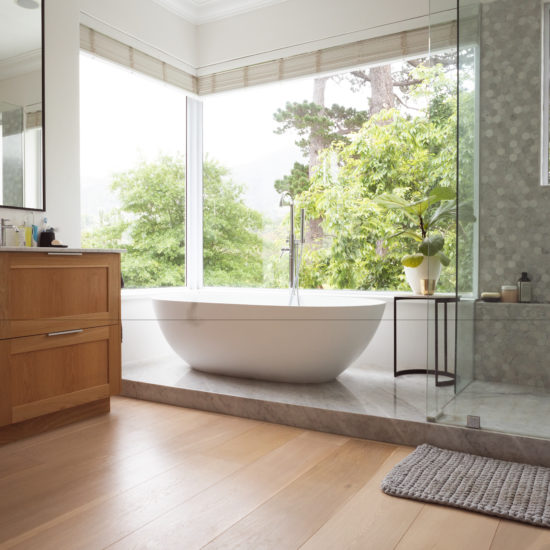
Without a doubt, one of the most essential spaces inside your property is the bathroom and/or wash closet (WC), and today we’re going to unpack a few practical tips for the ideal bathroom. Bathrooms have been trending on social media, throughout the pages of interior magazines, and a vital part in the selling or sale of a property too. However, cosmetics aside, one of the most important things to consider is the journey that you will need to walk in order to get from your current bathroom to the bathroom design of your dreams.
Our Top 7 tips for your bathroom design:
1. Be realistic about your budget
Before you tuck into the creative bits, such as colours, styling options, colours and all the other items on your wish list, remember that in a bathroom design and renovations the balance sheet comes before the mood board! Setting a realistic budget will help prioritise your needs and wants, and will also determine elements of your next steps. Although your budget doesn’t need to be set in stone, it’s wise to have an idea of what you are able to spend so that you can work out where to make savings should you want to make a splurge.
There are also smart ways to save on funds without cutting corners that may be essential to a well-executed renovation. The question is, are you replacing them for functional or for aesthetic reasons? If they are unattractive but operable, you may have options for dressing them up or for renewing them rather than replacing them. A great example would be considering the option of refinishing your existing bathtub with an attractive, protective coating instead of entirely replacing it. You can also paint your bathroom cabinet instead of sending it to the landfill and buying a new cabinet.
You can chat to our qualified team at Draw Plan about practical ways to make your budget work for your project, and we can explore these options with you. Alternatively, we can recommend an interior designer from our preferred vendor list using Supplier Connect by Draw Plan that can help you create a truly inspired space.
2. What are the needs for your bathroom?
Before you go rummaging through magazines and your Pinterest boards for inspiration and ideas, it is wise to start with your immediate needs for your bathroom. You need to look at who will be using the space and how they will be using the space. Is this the main family bathroom or an en-suite for two? Will the bathroom serve a washup-and-go lifestyle or is this meant to serve as a spa-like sanctuary? This will inform you on how the space needs to be designed, and direct you in terms of how much storage solutions need to be applied in the space.
If the space is going to be used as a family bathroom, then careful attention needs to be paid to things such as storage space, placement within the property as a whole, size and scale of the bathroom itself and entrances. Regardless of how you currently use your bathroom space, you need to think about how you wish to use it – this is how you can create something idyllic and practical.
3. Measure up your ideal space
If you are already in possession of your property’s drawing plans, then getting the measurements of your space should be easy to submit to your interior designer or to an expert architectural team, such as Draw Plan. However, if you don’t have this information available, either you can measure the space out yourself, or get one of our experts to do so for you during a site survey to get a more accurate reading.
Measuring your bathroom space, or the future space of your bathroom is going to be vital and will inform you on how your space can be used. Remember, spaces fill up quickly once you start placing the essentials, such as sanitaryware or other stoneware elements and furnishings. The last thing you want to do is end up with an uncomfortable space that is not very practical.
4. Seek inspiration for your bathroom
There are so many places where you can find inspiration for your bathroom, such as Instagram, Pinterest, magazines and so much more. A good place to start is by looking at the current aesthetic of your property. Look at colours, finishes and other elements to draw inspiration from. What is important is to understand both the practical applications of your bathroom as well as the energy and mood you want the space to resonate. In general, bathrooms are a place to begin your day or end your day. So they can either be invigorating or soothing. Either way, consider elements that will provide this energy for you in order to maximise your return on investment.
Some ideas could be colour, shapes, textures, finishes, light and shadow, and whether or not you want to include some other natural elements too such as plants and more. Regardless of your budget, start with what you want the space to feel like, and let the experts see how close we they can get to that vision within your budget.
5. Consider technology and other technical challenges
Depending on where you are located, you cannot plan a bathroom without due consideration to heating (or insulating), ventilation and maintenance. Granted that there have been quite a few technological advancements when it comes to heating, there may be a few technical challenges when considering this. These challenges are easily overcome with the correct flooring, such as wooden flooring or even vinyl. If you are considering stone flooring and tiles, you need to remember that if this is a renovation project, then the existing stoneware may be damaged or unsuitable for new sanitaryware. Potentially, you may have to reinforce your existing flooring and finishing or simply install all-new finishes. Using an anti-fracture or uncoupling matting underneath new floor tiles is a good idea if you are concerned about tiles cracking due to movement within the floor.
Underfloor heating is the perfect partner for hard, tiled floors and ideal for use in wet rooms and walk-in showers where it speeds up the drying out process of the floor; and adds to the overall heating of the space. This, however, needs to be planned with your architect as well as a certified electrician – and in some cases, you may need to review your building regulations permissions as well.
Remember, your bathroom should also be ventilated as this space will be exposed to wet conditions, steam and other elements that could impact the maintenance of the space. Your bathroom should be well-ventilated and allow for damp spots to be dried out as quickly as possible, especially for en-suites located next to a bedroom. An extractor fan is a good choice (albeit a noisy one) but make sure your electrician wires it in separately to your lighting, so you can control when it is on and off.
6. What about light sources?
Depending on what your planning permissions require, your bathroom may require additional natural light sources, such as windows or rooflights. You don’t necessarily want to depend on artificial lighting to brighten up the space. Your architect can make suggestions with regards to this, however, this will be decided upon once your planning approval is confirmed, and you have an interior designer or electrician you can consult with to map this out. What’s important is that your space is well-lit and that your lighting is spaced across multiple levels to provide a good flow of lighting throughout the space.
 7. The most important thing is sanitaryware
 7. The most important thing is sanitaryware
Whether you have a small bathroom or a grand oasis, our best recommendation is not to skimp on your sanitaryware. This includes your basin, bathtub, shower and toilet. These days bathtubs are used for both practical and aesthetic purposes. Although the standard bathtub size is 1700mm x 700mm, there are bigger and smaller sized baths available, and we would recommend that you explore all your options without limiting your imagination.
One crucial thing to note when you’re considering your sanitaryware and layout of your bathroom are clearance spaces. Your clearance space is important regardless of the size of your sanitaryware. And although there are no set rules for clearance spaces, we do have a few recommendations:
- Bathtub: Aim for a bath height of between 500mm and 600mm. Allow for a minimum of 530mm side clearance.
- Basin: A height of between 760mm and 1,190mm tends to be comfortable for most adults. A clearance of at least 510mm is required to the front — more if possible. According to Victoria Plum, the distance left to right (the span) should be at least 760mm.
- Shower: The minimum comfortable size for a shower enclosure is 760mm x 760mm. A clearance of at least 610mm is also required.
- Toilet: For close-coupled models, an overall toilet height of 595mm – 800mm suits most adults. The seat height should be 390mm – 460mm. The space around the toilet should be at least 760mm, with at least 510mm in front.
Wall-mounted basins, or semi-pedestal designs, can offer seamless integration into other furnishings and finishes and also allow the basin to be set at a height that works well for you and your family. Full-pedestal basins tend to be cheaper and give a more traditional look. And if your bathroom will include a shower, bear in mind that shower enclosures with doors that swing open will need enough space around them for the door to open and to allow you in and out. However, if your space is limited, then shower enclosures with fixed glazed panels or sliding shower doors will work well in smaller bathrooms.