

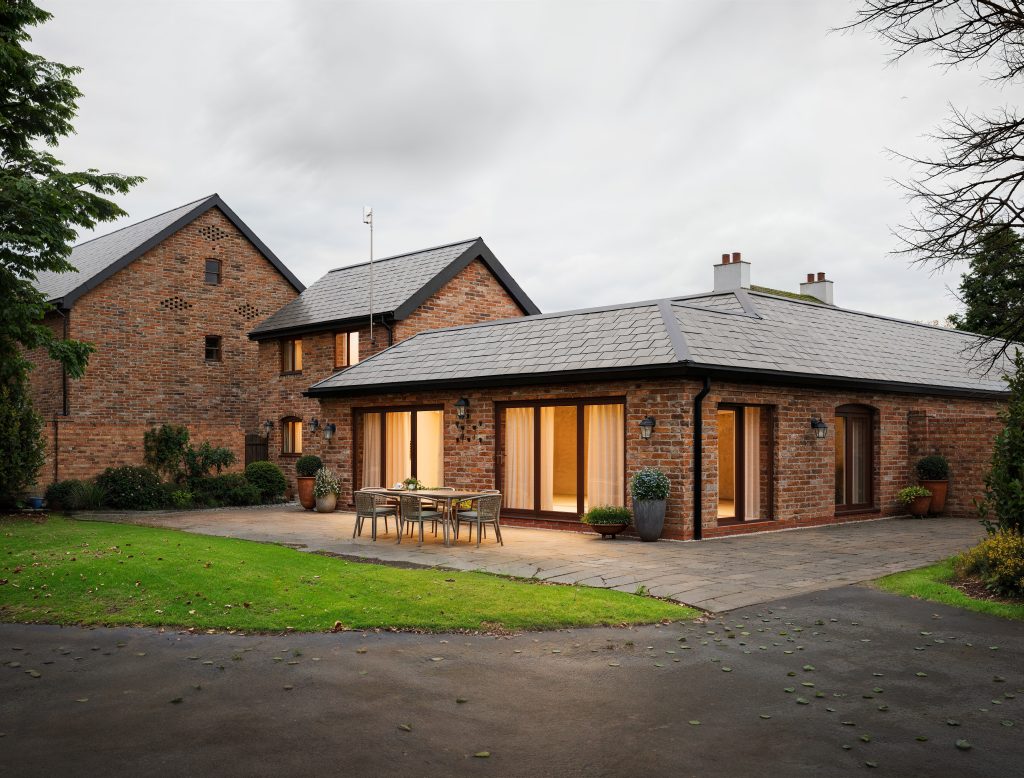
Building regulations are the technical standards that every construction project in England must meet, whether it is a rear extension in Wilmslow, a loft conversion in Hale, or a full interior reconfiguration in Knutsford. They exist independently of planning permission: a project can be fully approved under the planning system and still require separate Building Regulations approval before work begins. For Cheshire homeowners, understanding what triggers a Building Regulations application, what the process involves, and what it costs prevents delays, failed inspections, and the very real risk of being unable to sell a property with uncertified work.
This guide explains each Part of the Building Regulations relevant to residential projects, the approval routes available in Cheshire, the inspection process, costs, and what happens when work does not comply. If you are planning any building work on your property in Warrington, Prestbury, Alderley Edge, Bowdon, or anywhere in the North West, this is the regulatory framework you need to understand before a builder sets foot on site.
In this guide:
- What Building Regulations Actually Cover
- The Approved Documents: A Part-by-Part Breakdown
- When Building Regulations Approval Is Required
- Work That Is Exempt from Building Regulations
- The Two Approval Routes: Full Plans vs Building Notice
- The Inspection Process in Cheshire
- Building Regulations Costs and Fees
- The Completion Certificate and Why It Matters
- What Happens If You Do Not Get Approval
- How Draw Plan Supports Building Regulations Applications
- Book a Consultation
What Building Regulations Actually Cover
Building Regulations set minimum standards for the design and construction of buildings to ensure the health, safety, welfare, convenience, and sustainability of the people who use them. They are enforced by Building Control, which is either the local authority Building Control team (Cheshire East, Warrington Borough, or Trafford Council) or a private Approved Inspector.
The regulations apply to most building work, including new construction, extensions, structural alterations, changes of use, and the installation or replacement of certain building services (heating, electrical, glazing). They are entirely separate from planning permission: you may need both, one, or neither depending on the nature of the work. Our guide on whether you need an architect covers the distinction between planning and Building Regulations in more detail.
The Approved Documents: A Part-by-Part Breakdown
The Building Regulations are supported by a series of Approved Documents, each covering a specific technical area. For residential projects in Cheshire, the most commonly encountered are:
- Part A (Structure): Governs structural design: foundations, walls, floors, roofs, and any structural alterations. Required whenever load-bearing elements are modified, such as removing a wall to create open-plan living, installing a steel beam (RSJ), or adding a mezzanine. Structural engineer calculations are typically needed and form part of the Building Regulations submission.
- Part B (Fire Safety): Covers means of escape, fire detection, fire separation between rooms and between properties, and the fire resistance of structural elements. Critical for loft conversions (which often require a protected staircase and mains-wired smoke detection to LD2 standard under BS 5839-6), open-plan layouts that affect escape routes, and properties with integrated garages.
- Part C (Site Preparation and Resistance to Contaminants and Moisture): Addresses damp-proofing, subfloor ventilation, and resistance to weather and ground moisture. Relevant to extensions, basement conversions, and ground-floor alterations.
- Part E (Resistance to the Passage of Sound): Applies to conversions that create new dwellings (such as subdividing a house into flats) and to rooms used for sleeping that adjoin other habitable rooms. Sound testing may be required on completion.
- Part F (Ventilation): Sets requirements for background ventilation (trickle vents in windows), extract ventilation (bathrooms, kitchens, utility rooms), and whole-dwelling ventilation. Increasingly important with improved airtightness standards.
- Part G (Sanitation, Hot Water, and Water Efficiency): Covers WC provision, hot water storage safety (thermostatic mixing valves, unvented cylinder installations), and water consumption limits (currently 125 litres per person per day for new dwellings).
- Part K (Protection from Falling, Collision, and Impact): Governs staircase design (minimum headroom 2m, maximum riser height 220mm, minimum going 220mm for domestic), balustrade heights (minimum 900mm on stairs, 1100mm on landings and balconies), and glazing in critical locations.
- Part L (Conservation of Fuel and Power): Sets thermal performance standards for new building elements: U-values for walls (0.30 W/m²K), roofs (0.15 W/m²K), floors (0.25 W/m²K), and windows (1.4 W/m²K). Part L compliance is required for extensions, replacement windows, new heating systems, and any work that affects the thermal envelope.
- Part M (Access to and Use of Buildings): Requires reasonable provision for access into and within dwellings, including level or ramped access, minimum door widths (775mm clear opening), and accessible WC provision on the entrance storey.
- Part P (Electrical Safety): Requires electrical work in dwellings to be carried out by a registered competent person (Part P registered electrician) or inspected and certified by Building Control. Applies to new circuits, consumer unit replacements, and outdoor electrical installations.
When Building Regulations Approval Is Required
Most building work that affects the structure, thermal performance, fire safety, or services of a dwelling requires Building Regulations approval. Common triggers for Cheshire residential projects include:
- Extensions: All extensions require Building Regulations approval, even those built under permitted development. A single-storey rear extension must meet Part A (foundations and structure), Part L (insulation and glazing), Part B (fire safety), and Part P (electrical). Our
building regulations drawings for extensions guide covers the specific documentation required.
- Loft conversions: Require approval under Parts A (structure), B (fire safety, including protected staircase and detection), K (staircase design), F (ventilation), and L (insulation).
- Structural alterations: Removing or modifying load-bearing walls, forming new openings, or installing steel beams. Structural engineer calculations and Part A compliance are mandatory.
- Replacement windows and doors: Must comply with Part L thermal standards. Work must be carried out by a FENSA-registered installer (who self-certifies) or be covered by a Building Regulations application.
- New or replacement heating systems: Boiler replacements, heat pump installations, and underfloor heating all require Part L compliance. Gas Safe registration covers the gas safety element, but the energy efficiency aspect requires Building Regulations notification.
- Electrical work: New circuits, consumer unit changes, and outdoor electrical installations require Part P compliance. Most domestic electrical work is self-certified by a registered electrician under a competent person scheme (NICEIC, NAPIT, or ELECSA).
- Change of use: Converting a garage to habitable space, creating a home office from an outbuilding, or subdividing a dwelling all trigger Building Regulations requirements.
Work That Is Exempt from Building Regulations
Certain minor works are exempt from Building Regulations, including:
- Small detached buildings: Single-storey detached buildings under 15m² floor area (or under 30m² if non-combustible and at least 1m from any boundary) are exempt. This covers many garden sheds and small outbuildings.
- Conservatories and porches: Exempt if they are at ground level, under 30m², have independent heating controls, and are separated from the house by external-quality walls, windows, and doors.
- Like-for-like repairs: Replacing a roof covering with the same material, repointing brickwork, or replacing floorboards with equivalent materials are generally exempt.
- Internal decorative work: Plastering, painting, tiling, and non-structural internal finishes do not require approval.
The exemptions are specific and narrower than many homeowners assume. If in doubt, a feasibility assessment can confirm whether your planned work requires a Building Regulations application.
The Two Approval Routes: Full Plans vs Building Notice
There are two routes to Building Regulations approval in Cheshire:
Full Plans Application
This is the route Draw Plan recommends for all but the simplest projects. Detailed building regulations drawings are submitted to Building Control before work begins. The drawings are checked against the regulations, and a formal decision (approval, conditional approval, or rejection) is issued, typically within 5 weeks (or 2 months by agreement). This provides legal certainty that the design complies before construction starts.
Advantages of Full Plans:
- Pre-construction certainty: You know the design complies before spending money on building work.
- Formal record: The approved drawings provide a formal reference for the builder and for future sale of the property.
- Dispute resolution: If there is disagreement with the Building Control officer during construction, the approved drawings provide a clear baseline.
Building Notice
A Building Notice is submitted to Building Control at least 2 days before work starts, with no detailed drawings required upfront. The Building Control officer inspects the work as it progresses and raises any non-compliance issues at that point.
Risks of the Building Notice route:
- No pre-approval: There is no formal check that the design complies before work begins. Non-compliant work discovered during construction may need to be demolished or significantly altered.
- Not suitable for complex work: Building Notices should not be used for structural alterations, loft conversions, or any project where design decisions affect compliance. For anything involving structural engineering, the Full Plans route is essential.
The Inspection Process in Cheshire
Once work begins, the Building Control officer (from Cheshire East, Warrington Borough, Trafford Council, or an Approved Inspector) visits the site at key stages to verify compliance. For a typical extension project, inspection stages include:
- Commencement: Notification that work has started.
- Foundation excavation: Before concrete is poured, the inspector checks the foundation depth, width, and ground conditions against the approved drawings.
- Damp-proof course: Checked before walls are built up above DPC level.
- Oversite/ground floor: Verification of insulation, damp-proof membrane, and structural slab.
- Drainage: Before trenches are backfilled, drainage runs are inspected for falls, connections, and access points.
- Structural steelwork: Steel beams, padstones, and structural connections are checked before being enclosed.
- Pre-plaster: Insulation, fire stopping, ventilation, and structural elements are inspected before they are covered by plasterboard.
- Final inspection: Completed work is assessed for overall compliance, and a Completion Certificate is issued if satisfactory.
The builder is responsible for booking inspections at the correct stages. Missing an inspection can result in the inspector requiring work to be opened up for retrospective checking, which is disruptive and expensive.
Building Regulations Costs and Fees
Building Control fees in Cheshire vary by local authority and project type. For a typical residential project:
- Full Plans application fee (plan check): £150–£400 depending on project size and the local authority. This is paid on submission.
- Inspection fee: £300–£800 for the series of site inspections during construction. Some authorities charge this as a single fee; others split it across stages.
- Total for a single-storey extension: Typically £500–£1,000 in combined Building Control fees.
- Total for a loft conversion: Typically £500–£900.
- Approved Inspector fees: Private Approved Inspectors may offer competitive fees and faster turnaround for straightforward projects. Fees are broadly comparable to local authority charges.
These fees are separate from the cost of preparing the building regulations drawings themselves, which Draw Plan provides as part of our architectural service.
The Completion Certificate and Why It Matters
When all inspections are passed, Building Control issues a Completion Certificate. This is a critical document that confirms the work complies with the Building Regulations. It matters for three reasons:
- Property sale: Conveyancing solicitors require evidence that all building work has a Completion Certificate. Missing certificates are one of the most common causes of delay in Cheshire property transactions. Retrospective regularisation is possible but costs £400–£800+ and requires inspection of the work, which may be difficult or impossible if it has been covered up.
- Mortgage and insurance: Lenders and insurers may require evidence of compliance. Uncertified structural work can affect both mortgage approval and building insurance cover.
- Legal liability: Under Section 36 of the Building Act 1984, a local authority can require the removal or alteration of non-compliant work within 12 months of completion. In practice, enforcement can extend beyond this through injunction.
What Happens If You Do Not Get Approval
Carrying out notifiable building work without Building Regulations approval is a legal offence. The practical consequences for Cheshire homeowners include:
- Enforcement notice: The local authority can serve a notice requiring you to alter or remove non-compliant work.
- Prosecution: In serious cases, non-compliance can result in prosecution and fines.
- Sale complications: Without a Completion Certificate, selling the property becomes significantly more difficult. Solicitors acting for the buyer will flag uncertified work, and mortgage lenders may refuse to lend against the property.
- Regularisation: Retrospective Building Regulations approval can be sought through a regularisation application. This involves Building Control inspecting the existing work and issuing a regularisation certificate if it meets the required standards. However, the inspector may require intrusive investigation (lifting floorboards, removing plasterboard) to verify concealed elements. Fees are typically higher than a standard application.
The most cost-effective approach is always to obtain approval before work begins, with comprehensive drawings that give the builder clear instructions and the Building Control officer confidence in the design.
How Draw Plan Supports Building Regulations Applications
Draw Plan prepares detailed building regulations drawings for residential projects across Cheshire, from straightforward extensions to complex structural alterations and loft conversions. View our portfolio for examples of completed work, or explore our full range of services.
Feasibility Drawings – Initial design concepts and regulatory assessment to establish what your project requires before committing to a full design programme.
Planning Drawings – Planning application packages where required alongside Building Regulations submissions.
Building Regulations Drawings – Comprehensive technical drawing packages covering structural details, thermal calculations, fire strategy, ventilation, drainage, and electrical layouts for Building Control submission.
Book a Consultation
If you are planning building work in Cheshire and need to understand the Building Regulations requirements for your project, a no-obligation consultation is the best starting point. Whether it is an extension in Warrington, a loft conversion in Wilmslow, or structural alterations in Hale, Draw Plan can advise on the regulatory pathway and prepare the drawings you need for Building Control approval. Get in touch to book your free consultation.