

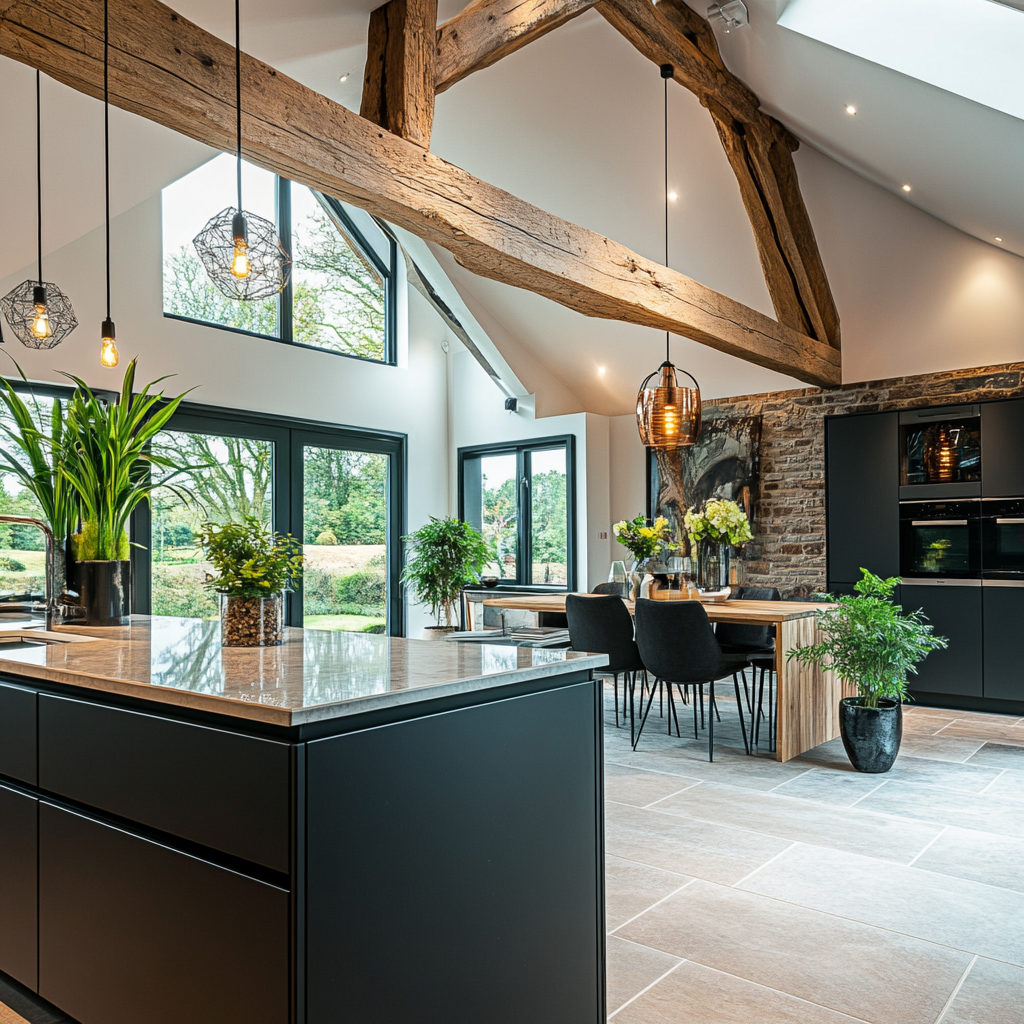
Finding the right architect for a luxury residential project in Cheshire is a decision that shapes everything that follows: the quality of the design, the smoothness of the planning process, the build quality, and ultimately the value and liveability of the finished home. In areas like Wilmslow, Hale, Alderley Edge, and Prestbury, where residential properties routinely command £1–5 million, the architect’s expertise is not a nice-to-have. It is the foundation the entire project rests on.
This guide covers the practical steps for finding, evaluating, and appointing a high-end residential architect in Cheshire and the North West, including what to look for in portfolios, how the fee structure typically works, what the design process involves, and how to assess whether a practice has the planning and regulatory knowledge your project demands.
In this guide:
- Define Your Brief Before You Search
- Where to Find High-End Residential Architects in Cheshire
- Evaluating Portfolios and Design Quality
- Checking Credentials and Professional Accreditation
- Assessing Local Planning and Regulatory Expertise
- Understanding the Design Process and RIBA Stages
- Architect Fees: What to Expect for Luxury Projects
- The Initial Consultation: What to Cover
- Sustainability and Technology Integration
- How Draw Plan Supports Luxury Residential Projects
- Book a Consultation
Define Your Brief Before You Search
The most productive architect search starts with a clear understanding of what you need. Before contacting any practice, spend time articulating your project scope, priorities, and non-negotiables. This saves time for both parties and immediately filters out practices that are not the right fit.
Key questions to answer before you start:
- Project type: Is this a new-build, a whole-house renovation, an extension, or a combination? A new-build on a plot in Prestbury is a fundamentally different commission to a sensitive refurbishment of a Victorian villa in Bowdon.
- Scale and budget: What is your realistic construction budget (excluding land and professional fees)? For luxury residential work in Cheshire, construction costs typically range from £2,000–£4,000 per square metre, depending on specification. A 300m² new-build at mid-luxury specification therefore sits at £600,000–£1.2 million before fees, landscaping, and furnishings.
- Style and ambition: Are you drawn to contemporary, traditional, or a contextual blend? Do you want to push design boundaries or create something that sits quietly within an established streetscape? In conservation areas across Hale, Knutsford, and Alderley Edge, this distinction has planning implications.
- Specific requirements: Home cinema, wine cellar, indoor pool, separate guest annexe, home office, multi-generational living accommodation. These shape the architect’s brief and affect the scale of practice you need.
Where to Find High-End Residential Architects in Cheshire
The most reliable routes to finding a capable luxury residential architect in the North West are:
- RIBA Find an Architect: The Royal Institute of British Architects maintains a searchable directory (architecture.com) filtered by location, project type, and budget range. Filtering for “residential” and “Cheshire” surfaces practices with verified RIBA Chartered status.
- Local reputation and referrals: In Cheshire’s affluent residential market, word of mouth carries significant weight. Speak to neighbours who have completed high-quality projects, local estate agents who see the finished results, and interior designers who collaborate with architects regularly.
- Builder and contractor networks: Established luxury builders in the North West (companies building at £2,500/m²+) work repeatedly with specific architects. Ask your preferred builder who they enjoy working with and why.
- Online portfolios and social media: Instagram and Houzz are increasingly where architects showcase completed work. Search location-specific hashtags and review the quality of photography, which often reflects the quality of the work itself.
- Award shortlists: RIBA regional awards, Cheshire Life property features, and local planning excellence awards highlight practices producing work that peers and critics recognise as exceptional.
Evaluating Portfolios and Design Quality
A portfolio is the single most important tool for assessing an architect. But evaluating it well requires looking beyond attractive photography.
What to assess in a portfolio:
- Relevance: Has the practice completed projects of similar scale, budget, and ambition to yours? A practice that excels at £100,000 extensions may not have the capability or systems for a £1 million new-build. Equally, a large commercial practice may not give a residential project the personal attention it deserves.
- Material quality: Look at the specification level in completed projects. Are the finishes, joinery, and detailing consistent with what you expect in your home? View our
portfolio for examples of the detail and finish level we deliver across Cheshire residential projects.
- Site visits: Where possible, visit a completed project in person. Photographs are curated and lit to flatter. Walking through a finished home reveals the quality of transitions between spaces, the feel of materials underfoot, and how the building handles light at different times of day.
- Range: Does the practice demonstrate versatility, or do all their projects look the same? The best luxury architects respond to each brief and site individually, rather than applying a house style.
Checking Credentials and Professional Accreditation
The title “architect” is legally protected in the UK. Only individuals registered with the Architects Registration Board (ARB) can use it. This is your baseline check. Beyond ARB registration, look for:
- RIBA Chartered Practice: Indicates the practice adheres to RIBA’s professional standards, quality management procedures, and continuing professional development requirements. Not all good architects are RIBA members, but the accreditation provides a quality floor.
- Professional Indemnity Insurance (PII): Essential. Your architect should carry PII that covers the full value of your project. For a luxury residential commission, this typically means cover of £1–5 million. Ask to see the certificate.
- Specialist accreditations: Passivhaus certification, conservation accreditation (AABC or CARE), or membership of the Society for the Protection of Ancient Buildings (SPAB) indicate specialist knowledge relevant to specific project types.
If you are unsure whether your project needs a registered architect or whether an architectural designer would suffice, our guide on whether you need an architect to draw plans explains the distinction and when it matters.
Assessing Local Planning and Regulatory Expertise
Design talent without planning knowledge is a liability. In Cheshire, where many luxury homes sit in conservation areas, Green Belt, or established residential character areas, your architect’s ability to navigate the planning system is critical.
Specific planning knowledge to look for:
- Local authority experience: Has the practice successfully secured planning consent from Cheshire East Council, Warrington Borough Council, or Trafford Council for projects comparable to yours? Each authority has different sensitivities and expectations.
- Conservation area expertise: Properties in parts of Hale, Bowdon, Knutsford, Prestbury, and Alderley Edge face additional scrutiny. The architect should understand how to prepare a compelling Design and Access Statement and manage the relationship with the Conservation Officer.
- Green Belt knowledge: If your site is in Green Belt (large parts of Cheshire), the architect must understand the policy framework around replacement dwellings, proportionate extensions, and the “very special circumstances” test.
- Building Regulations fluency: Luxury projects often involve complex structural alterations, large glazed openings, and sophisticated services installations. Your architect should be confident preparing comprehensive
building regulations drawings covering Parts A, B, L, M, and any other relevant sections.
Understanding the Design Process and RIBA Stages
A well-run luxury residential project follows a structured design process. The RIBA Plan of Work provides the industry-standard framework, and understanding it helps you evaluate how an architect proposes to manage your project.
- Stage 0–1 (Strategic Definition and Preparation): Defining the brief, assessing site constraints, and establishing the project budget. A
feasibility study at this stage tests what the site and planning context can accommodate before committing to a full design programme.
- Stage 2 (Concept Design): Sketch proposals, spatial diagrams, 3D visualisations, and material concepts. This is where the big design decisions are made and tested against the brief.
- Stage 3 (Developed Design): The concept is refined into detailed floor plans, elevations, sections, and outline specifications. This is typically the stage at which
planning drawings are prepared and submitted.
- Stage 4 (Technical Design): Full construction drawings, structural details, services coordination, and specification schedules. These documents allow builders to price accurately and construct without ambiguity.
- Stage 5 (Construction): Site monitoring, progress reviews, quality inspections, and decision support through to completion. For a luxury project, regular architect site visits (fortnightly as a minimum) protect the design quality through the build.
Architect Fees: What to Expect for Luxury Projects
Architect fees for luxury residential projects in Cheshire typically fall into one of three structures:
- Percentage of construction cost: The traditional model. For a full-service commission (RIBA Stages 0–5), expect 8–12% of the construction cost. On a £800,000 build, that’s £64,000–£96,000. This fee covers all design stages, planning and building regulations submissions, and construction-phase site visits.
- Fixed fee: Some practices quote fixed fees per stage, which provides budget certainty. A typical breakdown might be: feasibility £2,000–£4,000, concept design £5,000–£10,000, planning package £4,000–£8,000, technical design £8,000–£15,000, and construction support charged hourly or as a lump sum.
- Hourly rate: Some practices charge hourly for specific tasks (typically £80–£150 per hour for a qualified architect). This suits smaller, less defined scopes of work.
The fee should reflect the value delivered. An architect who secures planning consent for a scheme that adds £200,000 to your property’s value has more than earned a £60,000 fee. Equally, an architect whose poor planning strategy results in a refusal has cost you time, money, and momentum regardless of what they charged.
The Initial Consultation: What to Cover
Most reputable architects offer a free or low-cost initial consultation. Use this meeting to assess both capability and chemistry, because a luxury residential project typically spans 12–24 months and requires close collaboration.
Topics to cover in the first meeting:
- Your brief and priorities: Share your vision, budget parameters, and any constraints (planning, structural, timeline).
- The architect’s relevant experience: Ask for examples of comparable projects in Cheshire. Request client references you can contact.
- Their proposed approach: How would they structure the project? What stages do they recommend? Where do they see the key challenges and opportunities?
- Fee structure and scope: Get clarity on what’s included, what’s extra (structural engineer, party wall surveyor, specialist consultants), and how variations are handled.
- Communication style: How often will you receive updates? Who is your day-to-day contact? Will the principal or a junior architect lead the project?
Sustainability and Technology Integration
For luxury new-builds and major renovations in Cheshire, sustainable design and smart home technology are now standard expectations rather than optional extras.
- Energy strategy: Air source heat pumps, solar PV, battery storage, and MVHR (Mechanical Ventilation with Heat Recovery) are routinely specified in high-end Cheshire homes. Your architect should understand how these systems affect spatial planning, plant room requirements, and acoustic performance.
- Fabric-first approach: High-performance insulation, airtight construction, and triple glazing reduce energy demand at source. This is more effective than bolt-on renewables and contributes to a comfortable, quiet interior.
- Smart home infrastructure: Structured cabling, containment routes, and server cupboard locations designed into the building from Stage 3 avoid visible cables and costly retrofit. Systems like Lutron, Control4, or Loxone integrate lighting, heating, security, and audio into a single interface.
- EPC and future regulation: Current Building Regulations (Part L) set minimum thermal performance standards, but best-practice luxury builds significantly exceed these. An architect who designs to future standards protects your property’s long-term value.
How Draw Plan Supports Luxury Residential Projects
Draw Plan provides the full range of architectural drawings for luxury residential projects across Cheshire, from first concepts through to construction-ready documentation. Explore our full range of services or view our portfolio for completed residential work.
Feasibility Drawings – Initial design concepts, site appraisals, and viability assessments to test what your site and planning context can accommodate.
Planning Drawings – Full planning application packages for Cheshire East, Warrington Borough, Trafford Council, and other North West authorities.
Building Regulations Drawings – Detailed technical drawings covering structure, energy, fire safety, and access for Building Control approval.
Book a Consultation
If you are planning a luxury residential project in Cheshire, whether a new-build in Prestbury, a whole-house renovation in Wilmslow, or an extension in Hale, a no-obligation consultation is the best starting point. We will discuss your brief, review your site’s potential, and outline the design and planning pathway for your project. Get in touch to book your free consultation.