

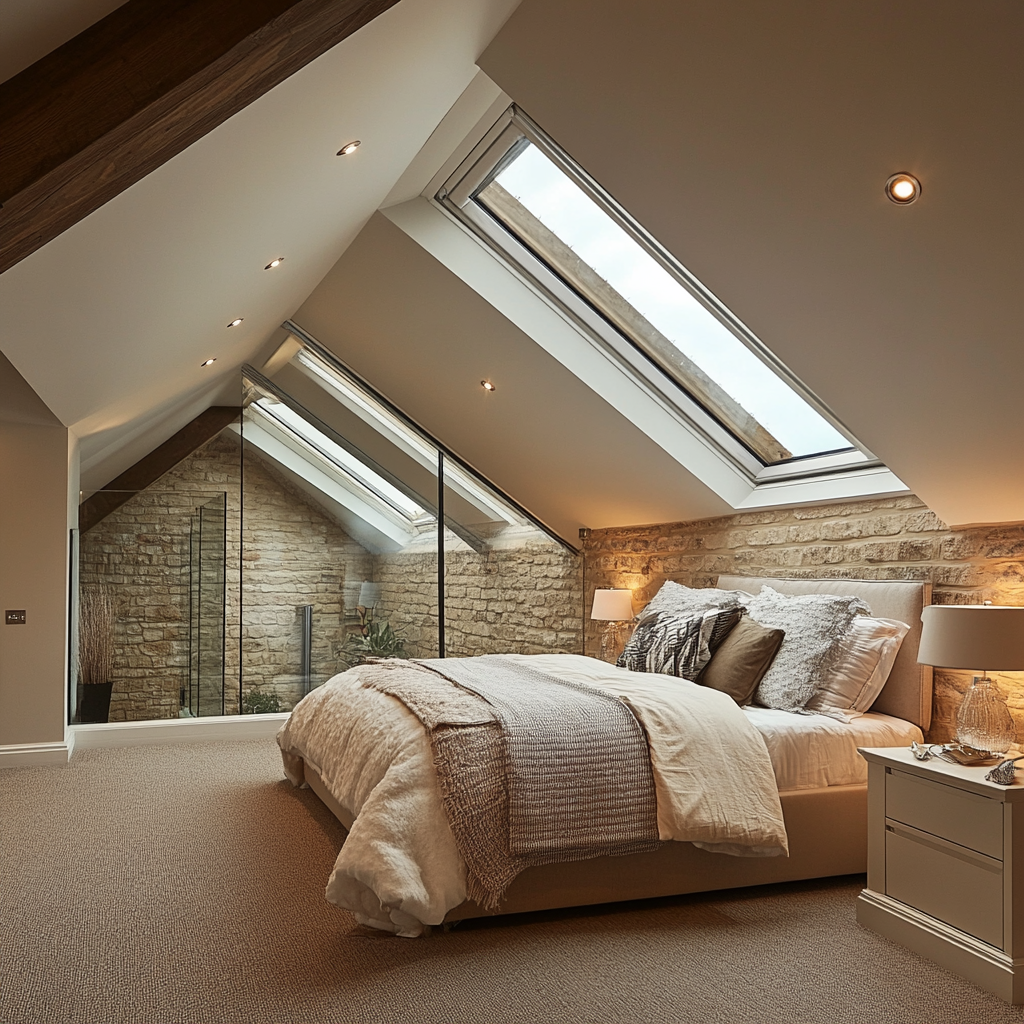
Cheshire’s most desirable homes share something in common: they almost always have untapped potential overhead. In Wilmslow, Alderley Edge, Hale, Prestbury and Knutsford, period properties and substantial detached houses frequently sit beneath generous roof spaces that never fulfil their promise. A well-executed loft conversion changes that, turning dead square footage into some of the most characterful living space in the entire property.
But luxury loft conversions in Cheshire require more nuance than a standard attic room. Conservation area restrictions in villages like Prestbury and Alderley Edge, structural complexities in Victorian and Edwardian properties, and the expectations of a premium market all demand specialist architectural input from the outset. This guide covers what actually matters: structural feasibility, planning permission and building regulations requirements, premium design approaches, and the real-world decisions that separate a £150,000 loft conversion from one that disappoints.
In this guide:
- Why Loft Conversions Make Sense for High-End Cheshire Properties
- Structural Feasibility: What Your Architect Checks First
- Planning Permission and Conservation Area Considerations
- Building Regulations for Loft Conversions: The Non-Negotiables
- Loft Conversion Types: Which Works for Your Property
- Premium Design Ideas for Cheshire Loft Spaces
- Luxury Finishes and Smart Home Integration
- Sustainability and Energy Performance
- What a Loft Conversion Costs in Cheshire (And What Drives the Price Up)
- How Draw Plan Delivers Luxury Loft Conversions
- Book a Consultation
Why Loft Conversions Make Sense for High-End Cheshire Properties
For homes valued above £750,000 in Cheshire’s golden triangle, a loft conversion is one of the highest-return improvements available. Unlike ground-floor extensions that consume garden space or require complex foundations, a loft conversion works within the existing building envelope. You gain usable area without sacrificing outdoor space, a significant consideration on plots in Hale Barns or Bowdon where landscaped gardens add real value.
The practical advantages for premium Cheshire homes:
- Maximising footprint without extending: Adding a full-height loft conversion to a four-bedroom detached in Wilmslow can deliver 40–70 square metres of additional living space, often at a lower per-square-metre cost than a rear extension requiring new foundations.
- Measurable value uplift: In Alderley Edge and Prestbury, where average house prices sit well above the national average, a quality loft conversion with en-suite and walk-in wardrobe typically adds 15–20% to property value. On a £1.2 million home, that’s a potential £180,000-£240,000 return.
- Flexibility of use: Master suites, dedicated home offices with dormer views across Cheshire countryside, home cinemas with full acoustic treatment, private gyms, guest suites with independent access. The best loft conversions adapt to how you actually live.
- Architectural character: Exposed roof timbers, vaulted ceilings, carefully positioned skylights framing treetop views. Loft spaces have inherent drama that ground-floor rooms rarely match.
Structural Feasibility: What Your Architect Checks First
Not every loft is convertible, and understanding structural constraints before committing budget is essential. A feasibility assessment identifies deal-breakers early and prevents wasted spend on planning applications for schemes that won’t work structurally.
Key structural factors your architect will assess:
- Head height: The critical measurement is usable floor area at 2.2 metres standing height. Most building control officers require at least 2.2m at the ridge for a habitable room. Many Edwardian semis in Warrington and older cottages in Lymm fall short without a dormer or mansard modification to increase headroom.
- Roof structure: Traditional cut-roof timbers (common in pre-1960s Cheshire homes) are generally easier to convert because the rafters and purlins can be modified or replaced with steel beams. Modern trussed roofs, found in many 1970s–90s estates around Warrington and Culcheth, require more extensive structural work because every truss is load-bearing.
- Floor loading: Existing ceiling joists are designed to support a plasterboard ceiling, not furniture, people and potentially a freestanding bath filled with water. Most loft conversions need new floor joists or steel reinforcement, particularly if the homeowner wants stone flooring or a luxury bathroom with heavy fixtures.
- Staircase positioning: Building regulations require a permanent, fixed staircase. Finding the right position is often the trickiest design challenge: it must provide compliant headroom at the top and bottom without stealing excessive space from the floor below.
- Services and fire safety: The loft conversion must integrate with existing drainage for any bathrooms, and Building Regulations Part B (fire safety) typically requires a protected escape route from the new storey down to the final exit.
In Cheshire, properties in conservation areas such as Knutsford, Prestbury or parts of Alderley Edge face additional constraints on external alterations. A feasibility study should always check whether dormer windows or roof-line changes will require specific conservation area consent before any design work progresses.
Planning Permission and Conservation Area Considerations
Many loft conversions fall within permitted development rights, meaning you can proceed without a full planning application. However, this depends on several conditions that are frequently misunderstood.
A loft conversion typically needs full planning permission if:
- The property is in a conservation area: Large parts of Knutsford, Prestbury, Hale, and sections of Alderley Edge and Wilmslow fall within conservation areas. Dormer windows, changes to the roof line, and certain materials may require explicit consent from Cheshire East or Trafford Council planning departments.
- The building is listed: Any alteration to a Grade I or Grade II listed building requires listed building consent in addition to planning permission. This is common with period properties in Chester, Knutsford and across rural Cheshire.
- Permitted development limits are exceeded: The volume added by the loft conversion (including any previous roof extensions) must not exceed 40 cubic metres for terraced houses or 50 cubic metres for detached and semi-detached properties.
- The design extends beyond the existing roof plane: Side-facing dormers on properties fronting a highway, or any extension that raises the existing roof height, will require planning permission even outside conservation areas.
Even when permitted development applies, we always recommend obtaining a Certificate of Lawful Development from the local authority. This provides written confirmation that the work is lawful and protects you if questions arise during a future sale. It’s a small investment that solicitors and buyers increasingly expect to see.
Building Regulations for Loft Conversions: The Non-Negotiables
Regardless of whether planning permission is needed, every loft conversion requires building regulations approval. This is non-negotiable, and signing off without it creates serious problems at resale. Building control will inspect structural modifications, fire safety provisions, insulation, electrics and any drainage work.
The core building regulation requirements for loft conversions:
- Part A (Structure): Structural calculations for any new beams, floor joists or steelwork. This applies to every conversion, including those using existing roof trusses with modifications.
- Part B (Fire Safety): A protected means of escape, typically requiring a 30-minute fire-resistant enclosure around the staircase from the new loft floor down to the ground floor final exit. Mains-powered, interlinked smoke alarms on every level are mandatory.
- Part L (Conservation of Fuel and Power): Loft conversions must meet current thermal insulation standards. For Cheshire properties, this typically means 270mm of mineral wool or equivalent between and over the rafters, plus insulation to any new dormer cheeks and walls.
- Part E (Sound Insulation): Particularly relevant if the conversion creates a bedroom above existing habitable rooms. Floor construction must include acoustic separation.
- Part P (Electrical Safety): All new electrical installations in the loft must be carried out or certified by a Part P-registered electrician.
- Part K (Protection from Falling): Balustrades, staircase guarding and window restrictors where the sill height is below 800mm from finished floor level.
Draw Plan prepares full building regulations drawing packages that cover every applicable part, submitted directly to your chosen approved inspector or local authority building control team. Having a complete set of technical drawings before any builder starts work prevents the costly mid-project changes that happen when building control raises issues during inspections.
Loft Conversion Types: Which Works for Your Property
The right conversion type depends on your existing roof structure, the head height available, your budget, and what the local planning authority will accept. Here are the four main types we design for Cheshire properties, with an honest assessment of where each one fits.
- Velux (roof light) conversion: The simplest and most cost-effective option. The existing roof structure stays largely intact, with roof windows installed into the existing slope. Works best on properties with generous ridge heights where you already have 2.2m+ standing room. Ideal for homes in conservation areas where dormers would not be approved. Budget range: £40,000–£65,000.
- Rear dormer conversion: The most popular type in Cheshire. A flat-roofed or pitched dormer extends from the rear roof slope, dramatically increasing usable floor area and standing headroom. Often falls within permitted development for detached and semi-detached properties. This is the sweet spot for most four- and five-bedroom homes in Hale, Wilmslow and Warrington. Budget range: £65,000–£120,000.
- Hip-to-gable conversion: Converts a sloping (hipped) side roof into a vertical gable wall, then adds a rear dormer. Common on 1930s semis and some detached properties across Warrington and Lymm. Provides significantly more space than a dormer alone. Budget range: £80,000–£130,000.
- Mansard conversion: The most dramatic transformation. The entire roof profile is rebuilt with a near-vertical rear wall and a flat top, maximising every square metre. Popular for substantial period homes in Prestbury and Alderley Edge where the homeowner wants a full additional storey. Almost always requires planning permission. Budget range: £100,000–£180,000+.
Premium Design Ideas for Cheshire Loft Spaces
The best loft conversions in Cheshire are designed around how the homeowner actually uses the space, not around generic room templates. Here are the configurations we design most frequently for premium properties in the area, with examples visible across our project portfolio.
Master Suite with Walk-In Wardrobe and En-Suite
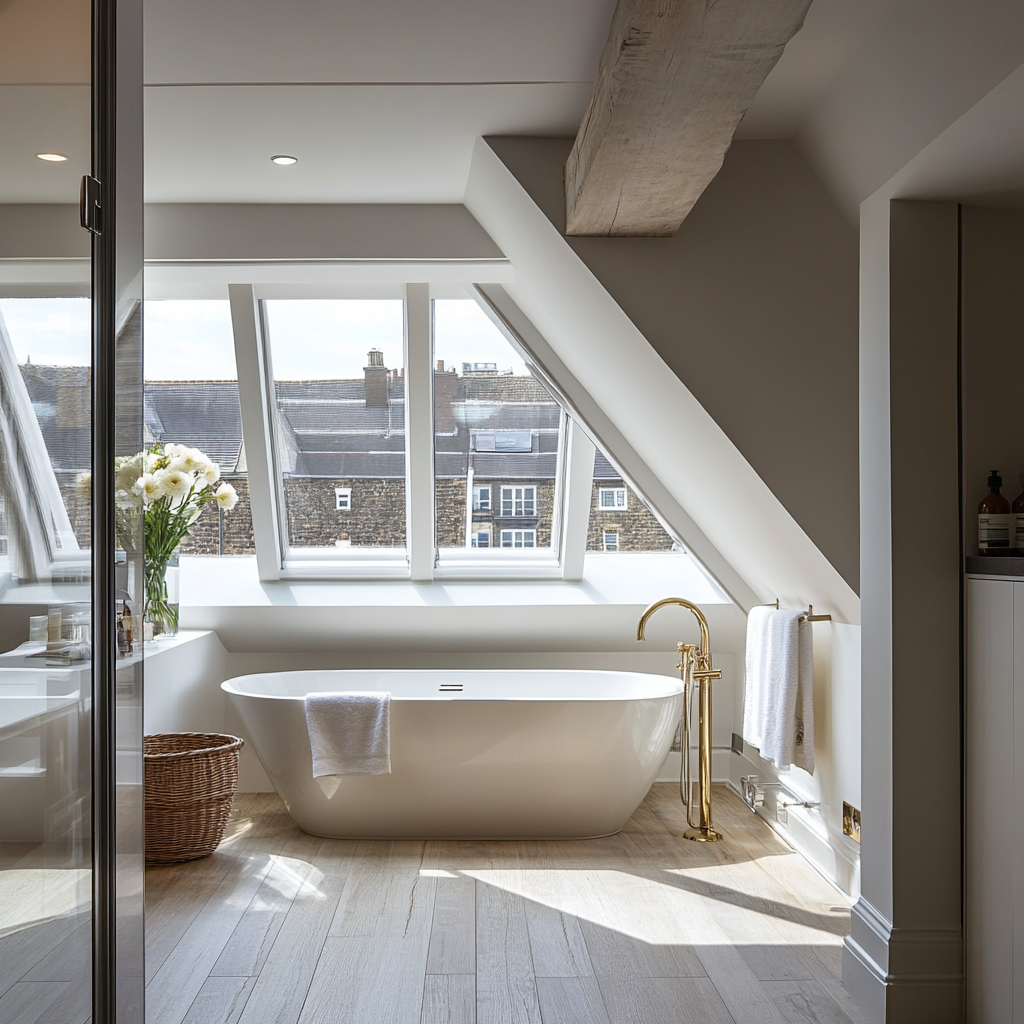
The most popular brief for homes in Wilmslow and Alderley Edge. A full loft-level master suite relocates the primary bedroom away from the family bedrooms below, creating genuine privacy. The key is designing the en-suite bathroom around the roof geometry rather than fighting it: a freestanding bath positioned under a Velux window, a walk-in shower in the full-height section, and vanity units tucked into the eaves. Walk-in wardrobes use the lower eaves sections where standing height is limited but storage depth is generous.
Dedicated Home Office with Dormer Views
For professionals working from home across Cheshire, a loft office provides genuine separation from family life. A rear dormer facing south or west floods the workspace with natural light while offering views over gardens or countryside. Bespoke joinery builds the desk, shelving and cable management into the roof structure itself. Acoustic insulation in the floor keeps the office quiet during school hours, and a separate internet access point ensures reliable connectivity for video calls.
Home Cinema and Entertainment Room
Loft spaces are inherently well-suited to home cinemas because they sit above the household noise. The sloped ceiling geometry actually benefits acoustic design, reducing parallel surfaces that cause flutter echo. Full acoustic treatment, blackout blinds to Velux windows, tiered seating, a dedicated AV rack and pre-wired surround sound create a genuine cinema experience. We design these with a small bar or drinks area in the eaves section, using the lower headroom creatively.
Private Gym and Wellness Space
Structural floor loading is the main design consideration: free weights, treadmills and a filled bathtub for a post-workout soak all impose significant point loads that standard loft floor joists cannot handle. We specify reinforced floor structures from the outset when a gym is part of the brief. Rubber matting over engineered floors, full mechanical ventilation (essential for a gym space with limited window openings), and oversized skylights for natural light complete the design.
Luxury Finishes and Smart Home Integration
The difference between a standard loft conversion and a premium one lies almost entirely in the specification. For Cheshire’s high-end market, the finishes and technology integration must match the rest of the home.
Finishes that define luxury loft spaces:
- Engineered hardwood flooring: Oak, walnut or herringbone patterns that complement the period character of the property. Engineered boards handle the minor movement that loft floor structures experience better than solid timber.
- Exposed structural elements: Retaining and restoring original roof timbers, steel beams left exposed with a brushed or painted finish, and brickwork in chimney breast features add authentic industrial character.
- Bespoke joinery: Custom wardrobes, bookcases and window seats designed specifically around the roof geometry. Off-the-shelf furniture rarely works in loft spaces because nothing is square.
- Stone and porcelain in bathrooms: Large-format porcelain tiles, natural stone vanity tops, and heated towel rails. Underfloor heating is almost standard in premium loft en-suites across Cheshire.
- Smart home integration: Automated Velux windows that open for ventilation and close if rain is detected, zoned underfloor heating controlled by app, integrated audio, and lighting scenes that adjust with time of day. Pre-wire during construction because retrofitting is expensive and disruptive.
Sustainability and Energy Performance
Building regulations already mandate high insulation standards for loft conversions, but going beyond minimum compliance delivers tangible comfort and cost benefits. In Cheshire’s larger homes, where energy bills can be substantial, a well-insulated loft conversion should reduce rather than increase overall heating demand.
Sustainable specification choices for premium loft conversions:
- High-performance insulation: Natural wool, wood fibre or aerogel insulation boards achieve excellent U-values without consuming excessive rafter depth. Aerogel is particularly useful in mansard conversions where every centimetre of internal space matters.
- Triple-glazed roof windows: Significantly better thermal and acoustic performance than double glazing. Essential for bedrooms and home offices where noise reduction and temperature stability are priorities.
- Mechanical ventilation with heat recovery (MVHR): Recovers up to 90% of heat from extracted air, providing fresh air without opening windows. Particularly valuable in loft spaces where summer overheating and winter condensation are both risks.
- Solar panel integration: If the roof orientation allows, incorporating solar PV into the new dormer or retained roof slopes integrates renewable energy generation into the conversion project.
What a Loft Conversion Costs in Cheshire (And What Drives the Price Up)
Transparent cost guidance is one of the most searched topics around loft conversions, and for good reason. The range is wide, and understanding what drives the price helps set realistic expectations.
Typical budget ranges for Cheshire loft conversions (2025/2026):
- Velux/roof light conversion: £40,000-£65,000. Minimal structural changes, no dormer construction.
- Rear dormer: £65,000-£120,000. The most common type for premium homes. Includes structural steelwork, new staircase, and en-suite.
- Hip-to-gable plus dormer: £80,000-£130,000. More structural work to modify the existing roof form.
- Full mansard: £100,000-£180,000+. Complete roof rebuild, typically the most spacious result.
What pushes costs higher:
- Bathroom complexity: A full luxury en-suite with underfloor heating, freestanding bath and walk-in shower adds £15,000–£30,000 depending on specification.
- Structural complications: Trussed roof conversions, chimney breast removal, or significant steelwork requirements increase structural costs.
- Conservation area requirements: Matching materials (handmade tiles, lime render, specific window profiles) add cost but are non-negotiable for planning approval.
- Smart home and AV integration: Pre-wiring and commissioning a full smart home system adds £5,000–£15,000 depending on scope.
The architectural fees for design, planning drawings and building regulations drawings typically represent 8–12% of the construction cost. On a £100,000 project, that’s £8,000–£12,000 for a complete drawing package that covers every stage from concept to construction. It’s the most cost-effective investment in the entire project because it prevents the expensive mistakes that happen when builders work without detailed technical drawings. For a broader look at what architectural services cost and when you actually need them, see our guide on whether you need an architect to draw plans.
How Draw Plan Delivers Luxury Loft Conversions
Based in Warrington with deep experience across Cheshire’s premium residential market, Draw Plan handles the full architectural journey for loft conversions. Our structured four-stage process ensures nothing is missed and every decision is informed by technical reality, not guesswork.
Our services for loft conversion projects:
- Feasibility Drawings – Structural assessment, measured survey, and design options to confirm what’s achievable within your roof space and budget before any commitment.
- Planning Drawings – Full planning application packages for dormers, mansards, and any work requiring conservation area or listed building consent. We manage the submission and liaison with Cheshire East, Warrington Borough or Trafford Council planning departments.
- Building Regulations Drawings – Complete technical drawing packages covering structural details, fire safety, insulation, drainage and electrical layouts. Submitted directly to your chosen approved inspector or local authority building control.
Every project starts with a free, no-obligation consultation where we visit the property, assess the roof space, discuss your brief, and give you an honest assessment of what’s possible. If a loft conversion isn’t the right solution for your property, we’ll tell you before you spend anything.
Book a Consultation
If you’re considering a loft conversion for your Cheshire home, the first step is understanding what’s structurally possible and what the planning position looks like. Get in touch with Draw Plan to book a free consultation. We’ll visit the property, assess the roof space, and provide clear guidance on feasibility, costs and timescales before you commit to anything.